
the complete guide
The Marriage Biodata Format, Explained Section by Section
A marriage biodata is a one-page introduction that families exchange when they begin looking for a match. It carries personal details, horoscope details, family background and one clear contact — usually with a photograph. Think of it as a résumé, except the people reading it are deciding whether two families should meet.
This guide walks through every section of a proper marriage biodata: what goes where, why it sits there, and what families actually look for. At the end you can build your own — not as a PDF that goes stale the moment you send it, but as a living link you update once and everyone sees.
Create my biodata — free →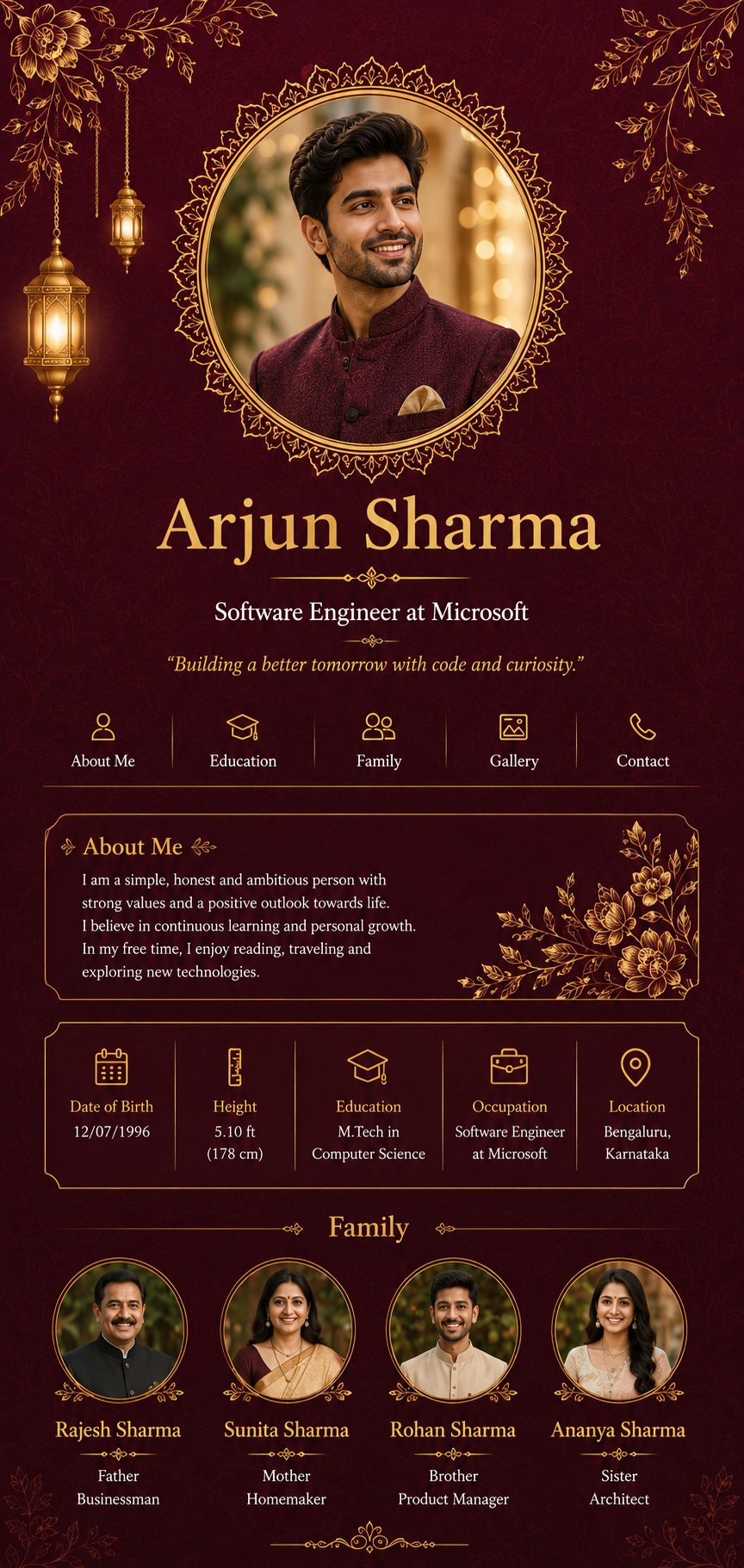
A clear 3:4 portrait at the top — recent and front-facing.
Full name with a one-line identity: role and city.
Date, time & place of birth, height, plus Rashi, Nakshatra & Gotra.
Qualification, work and city — answered before anyone asks.
Parents, siblings and native place — the household, in brief.
The Contact section — one name and number, so the right person calls.
123456- 1
Photograph. A clear 3:4 portrait at the top — recent and front-facing.
- 2
Name & headline. Full name with a one-line identity: role and city.
- 3
Birth & personal. Date, time & place of birth, height, plus Rashi, Nakshatra & Gotra.
- 4
Education & career. Qualification, work and city — answered before anyone asks.
- 5
Family. Parents, siblings and native place — the household, in brief.
- 6
One clear contact. The Contact section — one name and number, so the right person calls.
What is a marriage biodata?
A marriage biodata is a structured one-page profile used in arranged-marriage discussions across India. It summarises who you are — your background, education, family and horoscope — so that another family can form a first impression before anyone meets. People call it many things: shadi ka biodata (शादी का बायोडाटा), matrimonial biodata, marriage resume, wedding biodata. Same page, same purpose.
The difference between a biodata that gets a reply and one that gets ignored is usually not the design. It is whether it answers the obvious questions plainly, in the order families ask them.
What a marriage biodata is called across India
The same document goes by a different name in nearly every Indian language. Whatever your family calls it, the structure below is the one it follows.
| Language | What it's called | In script |
|---|---|---|
| Hindi | Shadi ka biodata | शादी का बायोडाटा |
| Marathi | Lagnacha biodata | लग्नाचा बायोडाटा |
| Tamil | Thirumana biodata | திருமண பயோடேட்டா |
| Telugu | Pelli biodata | పెళ్లి బయోడేటా |
| Bengali | Biyer biodata | বিয়ের বায়োডাটা |
| Gujarati | Lagna biodata | લગ્ન બાયોડાટા |
Where the biodata fits in the journey
In most arranged-marriage discussions the biodata is the very first step: families exchange it — usually on WhatsApp — before anyone speaks. If the page reads well, what follows in many families is horoscope matching, then a phone call between elders, then a family meeting, and, when everything feels right, a roka or engagement. Customs differ across communities, but the biodata's job is the same everywhere: earn the second step.
That is also why it pays to keep the biodata current for the whole search — a stale photo or an old job title at the family-meeting stage starts the conversation on the wrong foot.
What should a marriage biodata include?
A complete marriage biodata has four parts, in this order:
Personal details — full name, date, time and place of birth, height, religion, caste, and horoscope details (Rashi, Nakshatra, Gotra). Education, occupation and income sit here too, or just below.
Family details — father's and mother's names and occupations, siblings and their marital status, native place, and family values.
Contact details — one contact person, a phone number, and optionally an email or city. Just one clear point of contact, so the right person gets the call.
A photograph — a clear 3:4 portrait, if your family is comfortable including one.
Section one — the photograph, framed right
A biodata with a clear portrait gets warmer, faster replies. The expected shape is 3:4 — the same ratio every matrimonial photo is asked for. A well-cropped, recent, front-facing photo does more work than any decorative border. If your family or community prefers no photo, that is completely normal too, and a good design looks complete without one.
Section two — birth details, for the horoscope
Date, time and place of birth sit together near the top, because these are the three things elders check first when they want to match horoscopes. Keep them accurate to the minute where you can — a panditji matching kundlis will use exactly these.
Section three — Rashi, Nakshatra and Gotra
These are the fields most makers forget, and the ones traditional families look for immediately. Rashi (moon sign), Nakshatra (birth star) and Gotra (lineage) belong together, just under birth details. If your family does not follow them, leave them out — but if they do, their absence is noticed.
Section four — education and work, stated plainly
Qualification, occupation and income, answered before anyone has to ask. Name the degree, the role, and the city. If you work abroad, say so, with visa status. A biodata that answers the obvious questions upfront gets a phone call; one that makes people dig usually does not.
Section five — family, with room to breathe
Parents and their occupations, siblings and their marriages, native place, family values. Enough to give a picture of the home — but not so much that it reads like a census. Families are matching families as much as individuals; this section is where they read the household.
Section six — one clear point of contact
A name and a number at the bottom, so the right person gets the call. Usually an elder in the family. Keep it to one contact — a page with three numbers just makes people wonder whom to call.
Do this, avoid that
Do
- Use a recent, front-facing 3:4 photo
- Give birth time to the minute if your family matches horoscopes
- Name the degree, the role and the city — specifics read as confidence
- Keep one contact person, clearly named
- Proofread names and dates twice — elders notice
Avoid
- Sending a job resume instead of a biodata
- Three phone numbers and two email addresses
- Vague lines like “good family, well settled” with no detail
- A selfie or a heavily filtered photo
- Ten paragraphs — one page is the format
Pick a design and see the format live
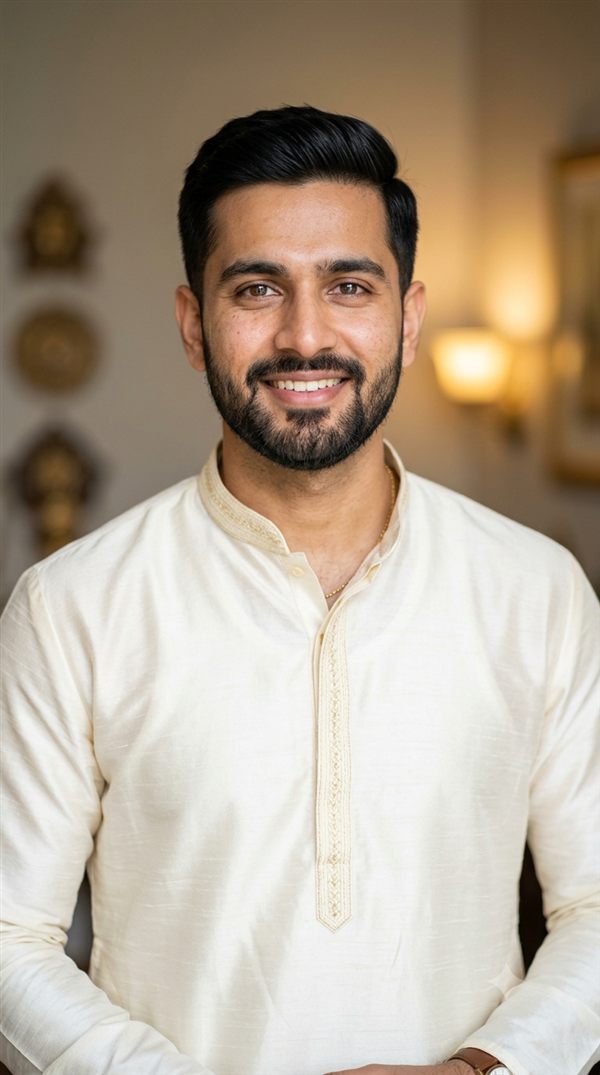
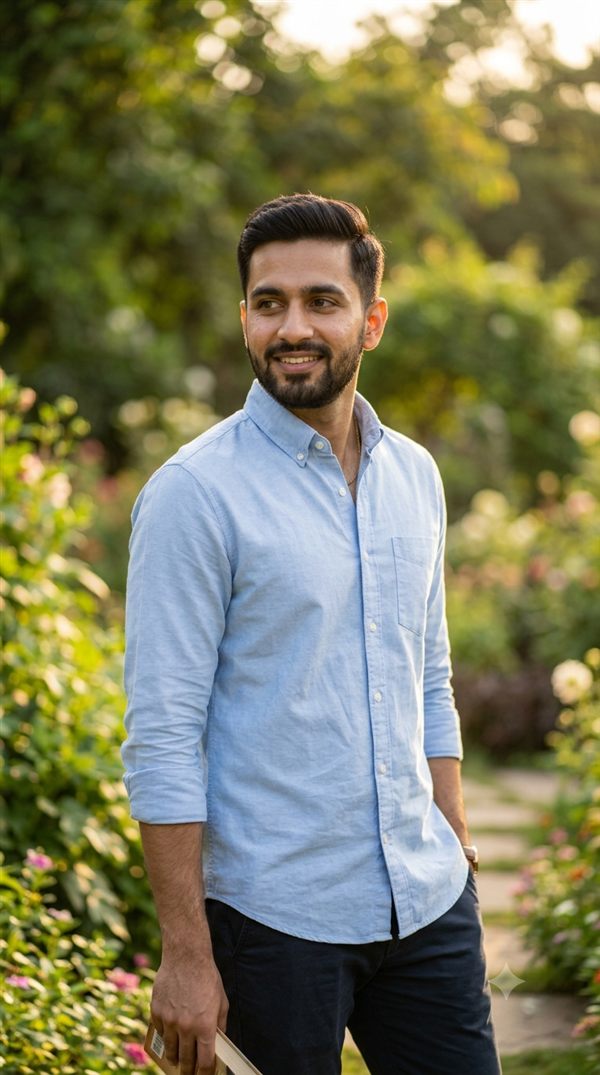
Mughal Gold

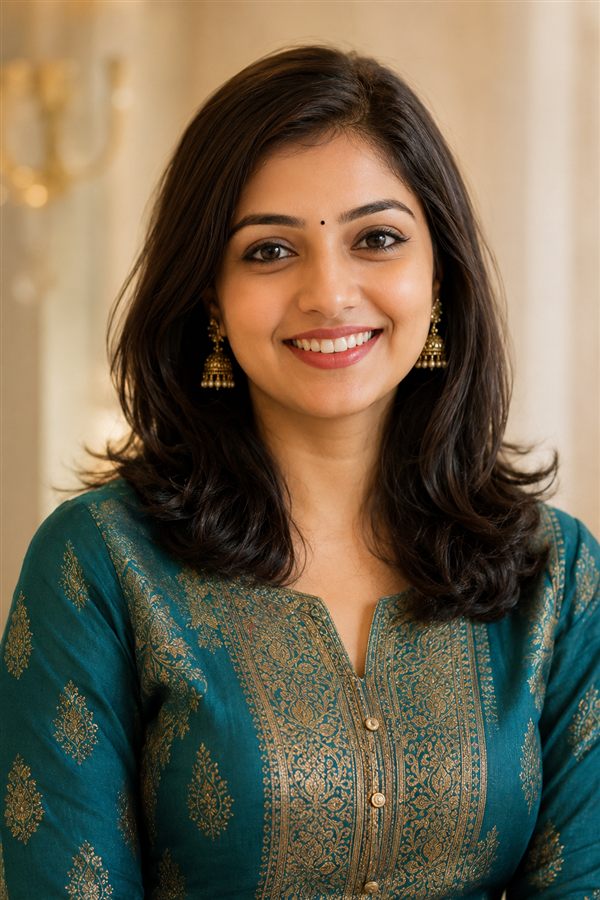
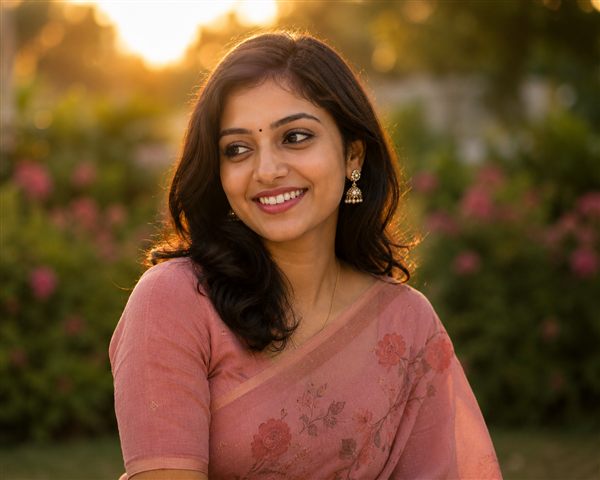

Sage Serenity
Celestial Dark


Navy Foil
See every design → All templates are free on every plan.
A biodata that lives, instead of one that expires
Here is where a Riishta biodata differs from a PDF or a Word file. A file is finished the moment you make it. Spot a typo, get a better photo, or want to switch a design, and you are making a new file and re-sending it to everyone who already has the old one.
A Riishta biodata is a living link. You edit it once, and everyone who already has the link sees the update — no re-sending, no “please ignore the earlier version.” You can still download a print-ready PDF or an image whenever you need paper or a quick WhatsApp send. You simply are not trapped in the file.
A living profile vs. a file
*Contact privacy available on paid plans.
Marriage biodata format for a girl (in brief)
A girl's biodata traditionally opens with personal and horoscope details, then education, then family — though many families now lead with her degree and designation. There is no single correct order, only the one that reads the way her family speaks. See the full marriage biodata format for girl guide, with a sample.
Marriage biodata format for a boy (in brief)
For a boy, the first questions are almost always qualification, occupation and income — so answer them early and plainly. Then family, then expectations. See the full marriage biodata format for boy guide, with a sample.
Formats for every community
Nearly every field on a Riishta biodata is optional — leave anything blank and it stays off the page — so any design adapts to your customs. We have dedicated guides for the Hindu marriage biodata, the Muslim marriage biodata and the Sikh marriage biodata, and you can build in Hindi, Tamil, Telugu, Marathi, Bengali or Gujarati.