
shubh vivah
The Hindu Marriage Biodata, With Horoscope Details Built In
A Hindu marriage biodata is a one-page profile that places horoscope details — Rashi, Nakshatra and Gotra — alongside personal, family and contact information, so that elders can begin matching kundlis from the first read. The details other makers make you type by hand are already here as proper fields.
Create a Hindu biodata — free →What makes a Hindu marriage biodata different
Three things that traditional Hindu families look for first, and that generic makers often miss:
Gotra
Lineage, checked to avoid same-gotra matches in many communities. A dedicated field, not an afterthought.
Rashi (moon sign) and Nakshatra (birth star)
The basis for horoscope matching. These sit near birth details, where a panditji expects them.
Date, time and place of birth, precise
Needed to cast and match the kundli accurately. On Riishta these are built-in fields — with proper dropdowns for Rashi, Nakshatra and Manglik status. If your family does not follow a particular one, leave it blank and it stays off the page.
The structure of a Hindu biodata
Most Hindu biodatas follow this order: an invocation or auspicious line (a Ganesha blessing, for instance), then the photograph, then personal and horoscope details, then education and career, then family, then contact. Traditional designs give the horoscope pride of place; modern ones keep it but quieten the ornamentation. Riishta offers both, and you can switch between them with your details already filled in.
Kundli milan: the eight kootas, briefly
When two Hindu families match horoscopes, most follow the Ashtakoota system — eight compatibility measures (kootas) scored out of a total of 36 gunas. This is exactly why the biodata carries precise birth details and Rashi and Nakshatra: they are the inputs. You do not need to compute anything yourself — but knowing what the panditji reads makes it clear why accuracy matters.
| Koota | What it weighs | Points |
|---|---|---|
| Varna | Temperament and outlook | 1 |
| Vashya | Mutual influence | 2 |
| Tara | Birth-star compatibility | 3 |
| Yoni | Nature and closeness | 4 |
| Graha Maitri | Mental compatibility | 5 |
| Gana | Disposition | 6 |
| Bhakoot | Emotional and material harmony | 7 |
| Nadi | Health and progeny — weighed heaviest | 8 |
Many families treat 18 of 36 as workable and 24+ as good, though conventions vary — some weigh Nadi above the total score. If your family does not follow kundli matching at all, that is equally normal: leave the horoscope fields blank and the biodata reads cleanly without them.
Invocations: how a Hindu biodata begins
Many Hindu biodatas begin with an auspicious line at the head of the page. Common choices include ॥ श्री गणेशाय नमः ॥ or a simple ॐ— and some families use a line honouring their kuldevta or a verse they hold dear. It is entirely a family's choice; Riishta's traditional designs carry these openings gracefully, and the modern ones look complete without any.
Regional conventions, briefly
The Hindu biodata takes a slightly different accent in every region. In Maharashtra, patrika details and native place (gaav) are usually prominent. In Tamil and Telugu families, the star and rasi — natchathiram and rasi, nakshatram and rasi — are often the first things elders read, and some families note dosham details. In Gujarat, community and native place are often stated early. In Bengal, biodatas sometimes travel through a ghotok, and read best clear and complete. None of these are rules — they are the accents families recognise, and a biodata that speaks in the family's own accent gets a warmer read.
A sample Hindu marriage biodata
Kavya Deshmukh
Chartered Accountant · Pune
Personal: DOB 3 September 1997, 6:42 am, Nashik · 5'5" · Hindu
Horoscope: Rashi: Tula · Nakshatra: Swati · Gotra: Kashyap
Education & Career: CA · Senior Associate, audit firm · Pune
Family: Father — retired bank officer; Mother — homemaker; one younger brother; native Nashik.
Contact: [one clear point of contact]
Notice how the horoscope line sits directly under the personal details — a panditji can lift Rashi, Nakshatra and the birth time straight off the page.
Do this, avoid that
Do
- Give the birth time to the minute — kundli casting uses it
- Keep Rashi, Nakshatra and Gotra together, near birth details
- Open with the auspicious line your family actually uses
- State native place — many families read it early
Avoid
- Pasting the full janam patrika onto the biodata — share it separately when asked
- Guessing the birth time — write “Not known” instead
- Leaving horoscope fields half-filled — all or none reads cleanest
- Heavy religious imagery on an otherwise modern design
Designs made for a Hindu biodata
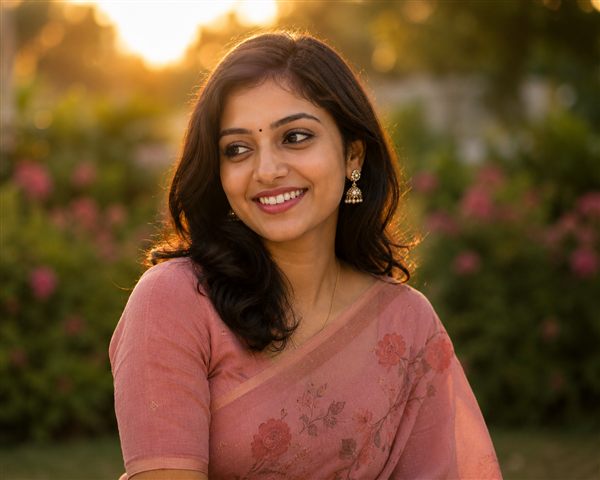
Ganesha Regal
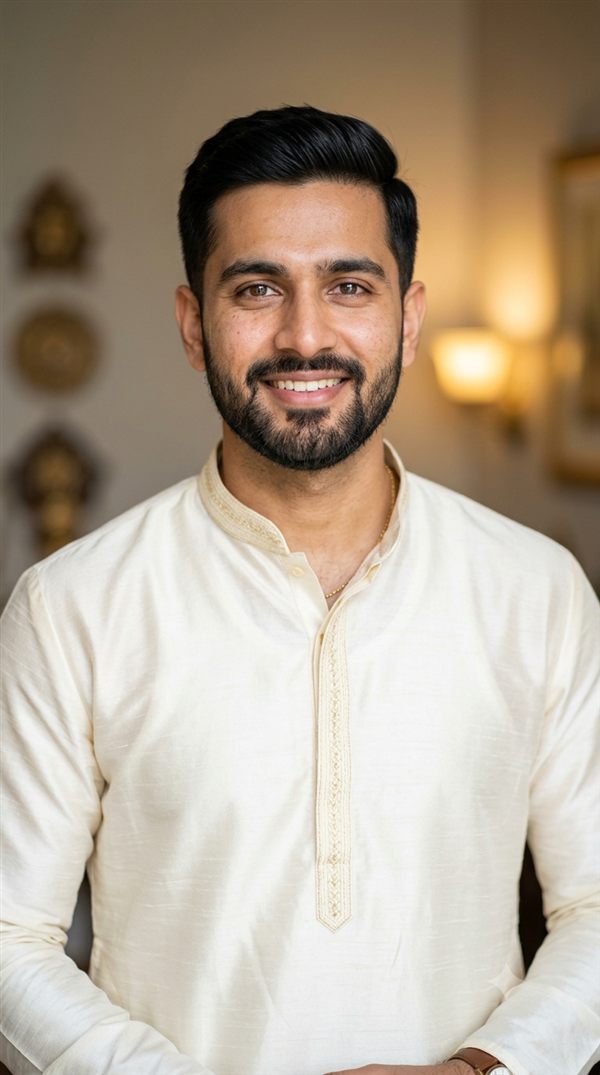

Mughal Gold


Sage Serenity
Celestial Dark
See every design → All templates are free on every plan.
A note on designs
Some families want a border that looks like it came off a wedding card; others want clean lines and no fuss. Riishta's traditional templates carry ornate borders and auspicious motifs, while the modern ones stay minimal. Every one adapts — Manglik status is built in, caste and sub-caste are entirely optional, and anything you leave blank stays off the page.
Keeping tradition and privacy together
A Hindu biodata often travels widely through community networks and WhatsApp groups. Riishta keeps it at a private, unguessable link that is never listed or indexed, and on paid plans the contact number stays hidden until you approve each request — so the biodata reaches the right families without the number ending up in every forward.
A living biodata for a search that takes time
Kundli matching, family meetings, and the back-and-forth of a traditional search all take time — and details change along the way. A Riishta biodata is a living link you edit once, so it stays current everywhere it has been shared. Download a print-ready PDF whenever an elder prefers paper.